
Estranged: To See Your Face

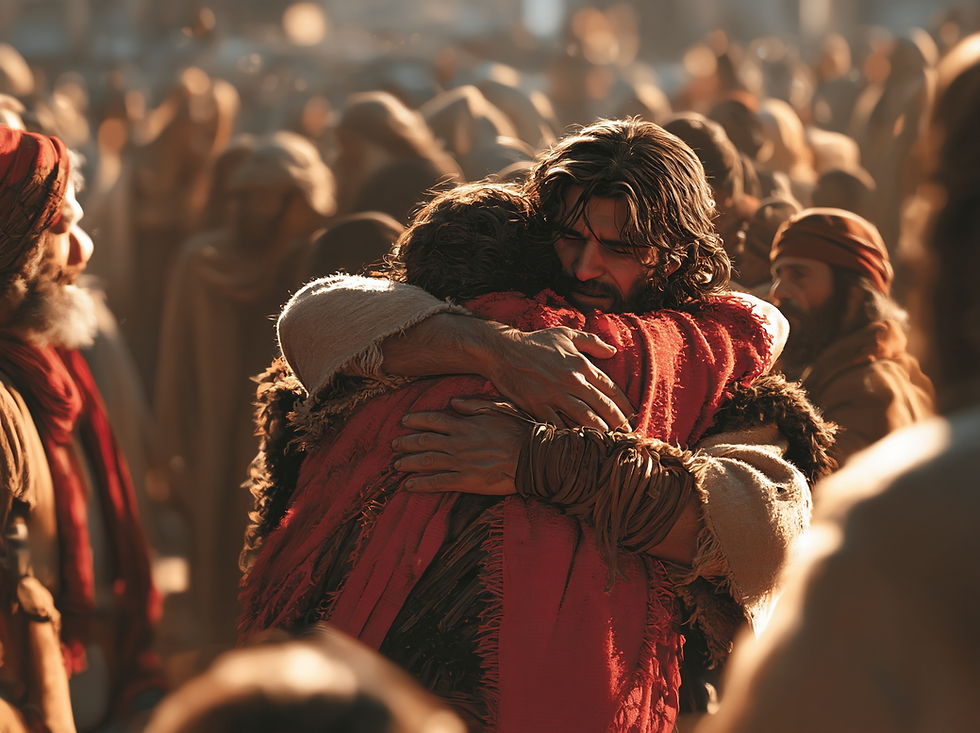
In a 2025 YouGov poll, nearly four in ten American adults said they were estranged from a sibling, a parent, a child, or a grandparent. That is not a small corner of the culture; for many of us it is the house next door, and for some it is our own. I've never betrayed my brother in any material way like Jacob did to Esau but the theme stands tall in a culture where family disputes are all too common. Family relationships have not really become more complex than in the days of Jacob and Esau but the causes might be different. I've known brothers to not talk to one another for many years because of something that happened a long time ago. When maturity was not always embraced.
Esau had a real reason. Jacob conned Esau out of his birthright by using his brother's hunger as the weakness. Then he took the blessing too, and Esau said so plainly:
"He took away my birthright, and behold, now he has taken away my blessing." (Genesis 27:36, ESV)
What followed was murder in his heart.
"Now Esau hated Jacob because of the blessing with which his father had blessed him, and Esau said to himself, 'The days of mourning for my father are approaching; then I will kill my brother Jacob.'" (Genesis 27:41, ESV)
Family feuds tend to be the worst kind of fighting that happens because it involves hatred, at some level, even when love previously prevailed. Then you involve generational family members with the same hatred and the resolution continues to grow angst between the parties. Scripture shows us exactly that. Generations later, Esau's descendants in Edom refused Israel passage through their land (Numbers 20:14–21). Amos said of Edom that "he kept his wrath forever." (Amos 1:11, ESV) And when Jerusalem fell, the prophet Obadiah charged them, "Because of the violence done to your brother Jacob, shame shall cover you." (Obadiah 1:10, ESV) Centuries on, God still called it violence against a brother.
Twenty years after he ran, God told Jacob to go home. He went praying, holding God to His own word, and he admitted what was in his chest:
"Please deliver me from the hand of my brother, from the hand of Esau, for I fear him." (Genesis 32:11, ESV)
Then he sent wave after wave of goats, camels, and cattle ahead of him, and the text tells us why:
"I may appease him with the present that goes ahead of me, and afterward I shall see his face. Perhaps he will accept me." (Genesis 32:20, ESV)
Many of us know that strategy. We rehearse the speech, plan the gesture, decide who should call first, and brace for the worst. It's hard to consider how someone would want to go towards someone they wronged in the way Jacob did. Yet he went. He put himself in front of his family and walked toward his brother, "bowing himself to the ground seven times, until he came near to his brother." (Genesis 33:3, ESV)
And here is what he found.
"But Esau ran to meet him and embraced him and fell on his neck and kissed him, and they wept." (Genesis 33:4, ESV)
When Jacob offered the gifts, Esau said, "I have enough, my brother; keep what you have for yourself." (Genesis 33:9, ESV) The text never tells us what changed Esau in those twenty years, and we should not pretend to know. What it tells us is what Jacob saw:
"For I have seen your face, which is like seeing the face of God, and you have accepted me." (Genesis 33:10, ESV)
The night before, at Peniel, he had seen God face to face and lived. Now acceptance in a brother's face looked like the same grace.
So where does a reconciliation begin? Self-examination is paramount in resolving lengthy disputes over time. Before we decide what the other person owes, we have to look at what we did, what we said, and what we have kept alive by refusing to let it go. I have stood on the wronged side of a moment like that myself. The anger was there. The justification was there. Then the passage was there. I slowed down. Lowered my position internally — that is the only phrase that fits. Began counting the other person as more important than myself. Decided to forgive the one stepping on me. The passage was Paul's:
"in humility count others more significant than yourselves." (Philippians 2:3, ESV)
Letting go of something that happened many years ago and offering up the kind of attitude Jacob did is much easier than you might think. With God's help we can do what is right and then solve many problems simply by stepping off our own self-made throne. Jesus put the going first:
"leave your gift there before the altar and go. First be reconciled to your brother, and then come and offer your gift." (Matthew 5:24, ESV)
Jacob sent his gift ahead of him; Jesus says to go before the gift.
The text is honest about the limits too. After the embrace, Esau went home to Seir and Jacob went on to Succoth. They were reconciled; they did not move in together. Paul gives the same honest measure:
"If possible, so far as it depends on you, live peaceably with all." (Romans 12:18, ESV)
Some divisions are not ours to end, and Jesus said that some division over Him would come, even inside a household (Matthew 10:34–36). But the part that depends on us is ours to carry.
The One we sinned against did not wait for us to arrive with enough gifts.
"All this is from God, who through Christ reconciled us to himself and gave us the ministry of reconciliation." (2 Corinthians 5:18, ESV)
He moved toward us first, while we were still His enemies (Romans 5:10), and He asks the same of us:
"as the Lord has forgiven you, so you also must forgive." (Colossians 3:13, ESV)
People who have been received like that have a reason to go first.
If there is a brother, a sister, a parent, or a child you have not really spoken to in years, the road may be shorter than the fear. Before time is no more and the moment is lost forever. Don't let something from the past steal away the beauty of a future together.
Scripture quotations are from the ESV® Bible (The Holy Bible, English Standard Version®), copyright © 2001 by Crossway, a publishing ministry of Good News Publishers. Used by permission. All rights reserved. ESV Text Edition: 2016.
Drafted with AI assistance from Herbert Berkley's own words and reviewed by him.


