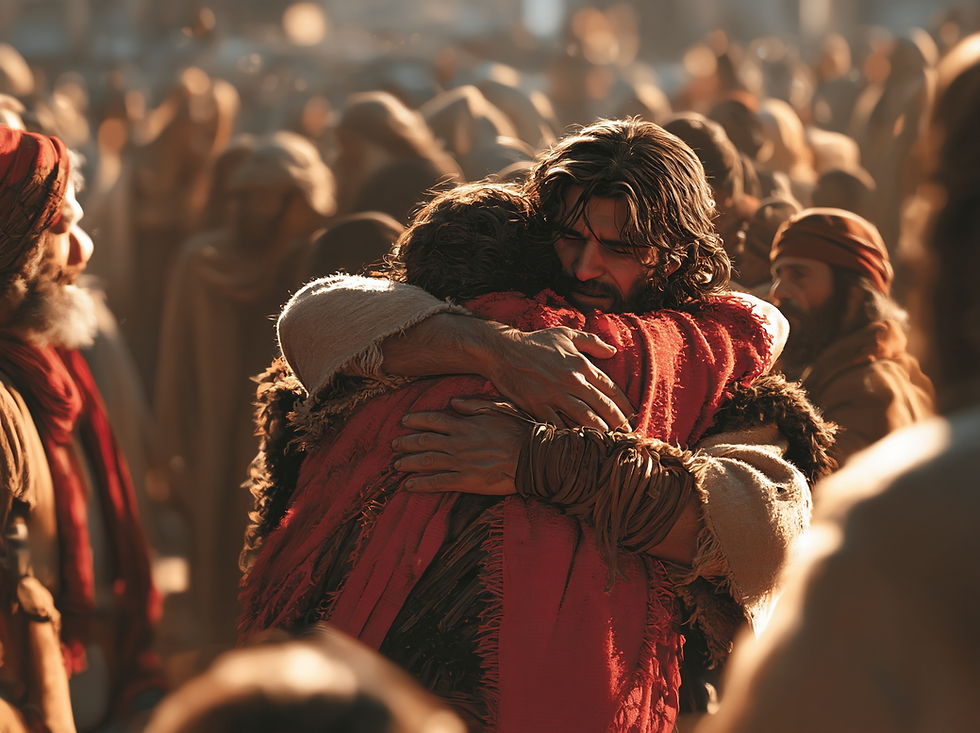
QFD | The Crossing


The Crossing
Romans 1:24, 26, 28 | ESV
"Therefore God gave them up in the lusts of their hearts to impurity, to the dishonoring of their bodies among themselves, because they exchanged the truth about God for a lie and worshiped and served the creature rather than the Creator, who is blessed forever. Amen." — Romans 1:24–25, ESV
Several years back I was deep on the Ozark Highland Trail, far enough in that paved roads and cell towers were a different world. The trail bent down to a river crossing. In dry season you could hop from rock to rock — placed and reinforced, each one a reliable hold. But that day the water was up from snowmelt higher on the mountain, running fast and brown, and the rocks had disappeared under the current. The easy crossing was something else now.
You could still get across. The current would just decide where you landed.
I have been thinking about that river for a long time. Not because of what the trail looked like from the outside, but because of what I know about how I have crossed rivers in my own life. There have been seasons where the rocks were still there, still solid underneath, and I stepped off them anyway. Not in open rebellion against God. Just in ambition. In the particular blindness that comes when something starts delivering — when the career is building and the name is rising and everything looks, from where you are standing, like momentum.
There was more than a season of that for me. I traded trust in God for human validation. I put career and life pursuits above the call of the Kingdom. I was building something that felt, from the inside, like the right direction. The tower was going up. The name was being made. Looking back I can see what I could not see then — that I was not building toward something. I was building myself. The ambition had quietly become the point.
That is not an unusual story. Genesis 11 records a whole civilization doing the same thing. The people of Shinar looked at what they could accomplish and said, let us build a tower to the heavens, let us make a name for ourselves. The dangerous version of that ambition — the one that does the most damage — is the kind that rarely identifies itself as defiance. They were building something impressive. They were moving forward. They were making their mark on the world. The exchange — self-glory over God-glory, the creature elevated above the Creator — was already complete before the first brick was mortared. The exchange is rarely announced. The building just starts.
The dangerous tower — the one that does the most damage — is built in ambition, not defiance. The builder rarely sees the difference until the ground starts moving. The exchange is already complete before the first stone is laid.
And underneath that ambition, doing the work that ambition cannot see, is Satan.
Satan does not come to you in obvious defiance. He is not interested in your rebellion — rebellion is too visible, too easily named and repented of. What Satan wants is your desire. He comes to you through the thing you already want, wears the clothing of your particular ambition, and offers what looks exactly like what God would want for you — except the source has quietly changed hands. The aim has shifted from the Kingdom to the self, and it feels like the same thing because for a while it produces similar results. The affirmation arrives. The accomplishment compounds. The ascent continues.
He did this to Jesus. Satan took Him to a very high mountain and showed Him all the kingdoms of the world in their glory and said: "All these I will give you, if you will fall down and worship me" — Matthew 4:8–9, ESV. The elevation was real. The kingdoms were real. The offer was real. Notice what Satan is offering — not something counterfeit, not a fake version of greatness. He is offering actual dominion, actual glory, actual kingdoms. The only thing he is changing is the pathway. Skip the cross. Take the shortcut. Get the crown without the suffering. The content of the offer is not a lie. The lie is in who you give yourself to in order to receive it.
That mechanism — redirecting legitimate desire away from God toward the self — is not new. Satan ran it in the garden before he ran it on the mountain. He ran it on himself before either, standing in the courts of heaven and saying I will ascend, I will raise my throne, I will make myself like the Most High. His fall was the original exchange. Every subsequent version is a replication, wearing the costume of a particular person's particular desire in a particular moment.
When that season of building finally started to unravel for me, the chaos was not immediately legible as consequence. It just felt like things falling apart. Like pressure from everywhere. Like the ground that had seemed solid was not. Only later — much later — did the shape of it become clear. The downstream had always been the river. The current had always been pulling. I had simply been calling it freedom.
That is how you know it was the offer. It felt like ascent.
*
What Paul lays out in Romans 1 is not primarily a catalog of cultural sins, though people have used it that way long enough that it is hard to hear it fresh. What Paul is actually doing is describing a mechanism — a sequence that begins long before anything visible occurs, in territory so ordinary it does not feel like the beginning of anything.
Before verse 24, before the first God gave them up, there is a pre-condition. Paul describes it in verses 18 through 23. The suppression of what is clearly seen — because God, Paul says, has made plain to every human being the evidence of His eternal power and divine nature through what He made. The creation is not neutral. It is testifying. It has been broadcasting since the first morning, a low-frequency signal that never stops, and the work required to silence it is not passive. Suppression is active. It takes sustained effort to quiet what is being continuously transmitted.
Then comes the failure to honor God or give thanks. The thinking that calls itself sophisticated while becoming hollow. The claim to wisdom arriving at precisely the moment the wisdom departs. All of this is ordinary life. None of it looks, from the inside, like the beginning of a fall. It looks like a person moving through the world, managing their life, building what they are building. The tower is going up. The current is moving fast. And then Paul writes the phrase that changes the register of everything: "Therefore God gave them up in the lusts of their hearts to impurity, to the dishonoring of their bodies among themselves, because they exchanged the truth about God for a lie and worshiped and served the creature rather than the Creator, who is blessed forever. Amen." — Romans 1:24–25, ESV.
The Greek word Paul uses is paradidōmi. It is a legal term. It is the word used when a prisoner is handed over to the court, when Jesus is delivered to Pilate, when Paul himself is delivered into Roman custody. God gave them up is not God walking away in grief or turning His back in disgust. It is God issuing a judicial verdict on a crossing that has already been made. The exchange preceded the verdict. The giving over is the consequence of the exchange, not the beginning of it.
And the verdict has a particular shape. Paul uses paradidōmi three times, and each time the giving over goes deeper.
The first is internal. God gives them up to the lusts of their hearts. Desire is now on the throne. Not desire as God designed it — broad, aimed at Him, built to find its satisfaction in the One who made it. Desire redirected, narrowed, aimed at the creature instead of the Creator. From the inside this feels like freedom. Like finally moving without constraint. Like permission. That feeling is the first rock disappearing under the current.
The second goes to the body. God gives them up to dishonorable passions. Identity begins to follow desire — the self remade in the image of what now governs it. This stage does not feel like corruption from the inside. It feels like authenticity. Like finally being honest about who you are. The language of authenticity is almost always the language of stage two, because stage two is the stage where the self has become the reference point and the self almost always feels like truth.
The third reaches the mind itself. God gave them up to a debased mind. The faculty of self-correction — the part that could have named what was happening at stage one, that could have recognized the offer at stage two — handed over. Compromised from inside. This is the most sobering part of what Paul establishes, because at stage three it is not that the person refuses to see. It is that the instrument of seeing has been given over to the same current it was supposed to evaluate. The judge has become the defendant.
God does not chase you into the current. He ratifies the crossing you already chose.
Each stage removes one more thing that could have named what was happening. By the time the damage is visible from the outside, the mind that would have named it has already been handed over.
*
Paul does not give the reader a moment to settle into the observer seat after this. There is no pause to let the diagnosis land as commentary on someone else's life. The very next thing he writes is:
"Therefore you have no excuse, O man, every one of you who judges." — Romans 2:1, ESV
The person who just nodded through the diagnosis in chapter one — the one who recognized the exchange, named the stages, felt the weight of the giving over — Paul turns the text toward that person now. You are not the audience for this indictment. You are the subject of it. The one who catalogues another person's drift is still standing in the river. The rocks are just as covered. The current is just as indifferent to where you land.
I sat with that for a long time after the tower years. I could see the pattern clearly in the culture, in people I knew, in the broad story of a generation trading the signal of creation for the noise of screens and the religion of self. I could trace the three stages in movements all around me. What I was slower to see was the same fingerprint in my own life. The same exchange. The same ambition wearing the same clothing. The same current that felt, from inside it, exactly like walking.
What finally opened that up for me was understanding that this is not just my story. It is not even primarily a human story. It is Satan's story, replicated.
Satan was cast from heaven because he attempted the original exchange — creature-glory over Creator-glory, his own name over God's name, his own ascent above the throne of the Most High. He fell for the very thing he now manufactures in us. And here is what makes that significant: Satan does not tempt you simply to cause damage. He tempts you because your fall is his argument. Every exchange you make, every stage of the giving over you walk into, is evidence Satan is presenting before a throne he was cast from — evidence that what he pursued was worth pursuing, that the exchange is rational, that God's claim on His creation is not legitimate. Your drift is not just your story. It is his case.
That reframe changed everything about how I understood my own tower-building years. The chaos was not random. The pressure was not impersonal. There was something being argued over my life at a level I could not see from inside the ambition. And the Jesus who refused Satan's offer on the mountain — who said "You shall worship the Lord your God and him only shall you serve" — Matthew 4:10, ESV — was not only modeling obedience. He was defeating the argument. Every time He refused the exchange, He was dismantling the case.
He is still dismantling it. That is the story you have been placed inside.
The ache that lives underneath your life — the tension that surfaces in the quiet, that the noise is designed to suppress, that the tower-building was built to outrun — that ache is not a malfunction. Every human being carries it, whether they have named God or not. The ones who have never walked into a church still feel the friction of the signal creation will not stop broadcasting. The ones who have found the Jesus of the New Testament and been buried with Him in baptism know it from the inside — not as doctrine but as recognition. They have crossed. They know what was pulling. They know what the rocks are. They know what the other side feels like.
The rocks are still there under the current. The trail still goes to the other side.
The cross is where it all resolves. Not as a theological footnote at the end of the diagnosis — as the answer to every exchange the diagnosis names. Jesus did not simply refuse Satan's offer on the mountain. He went to the place where the full weight of the three-stage giving-over lands, where the judgment that paradidōmi carries arrived in full, and He absorbed it. The exchange humanity made in the garden, the exchanges we have made in our own ambitions and towers and river crossings — He took the verdict of all of them on a Roman cross outside Jerusalem. "He himself bore our sins in his body on the tree, that we might die to sin and live to righteousness." — 1 Peter 2:24, ESV. The argument Satan has been building before the throne — your failure as his evidence — was answered there. Not dismissed. Answered. With a body. With blood. With a grave that did not hold.
That is the other side the trail leads to. Not a better version of the life you were building. The life that was purchased when someone else took the current for you.
*
The ache you have been medicating with everything except God is not a wound. It is a witness. It has been telling the truth about you since before you had words for it.
Developed with the assistance of AI writing tools, under the author's full theological review and final editorial control.