Are We Free?
Updated: Sep 2
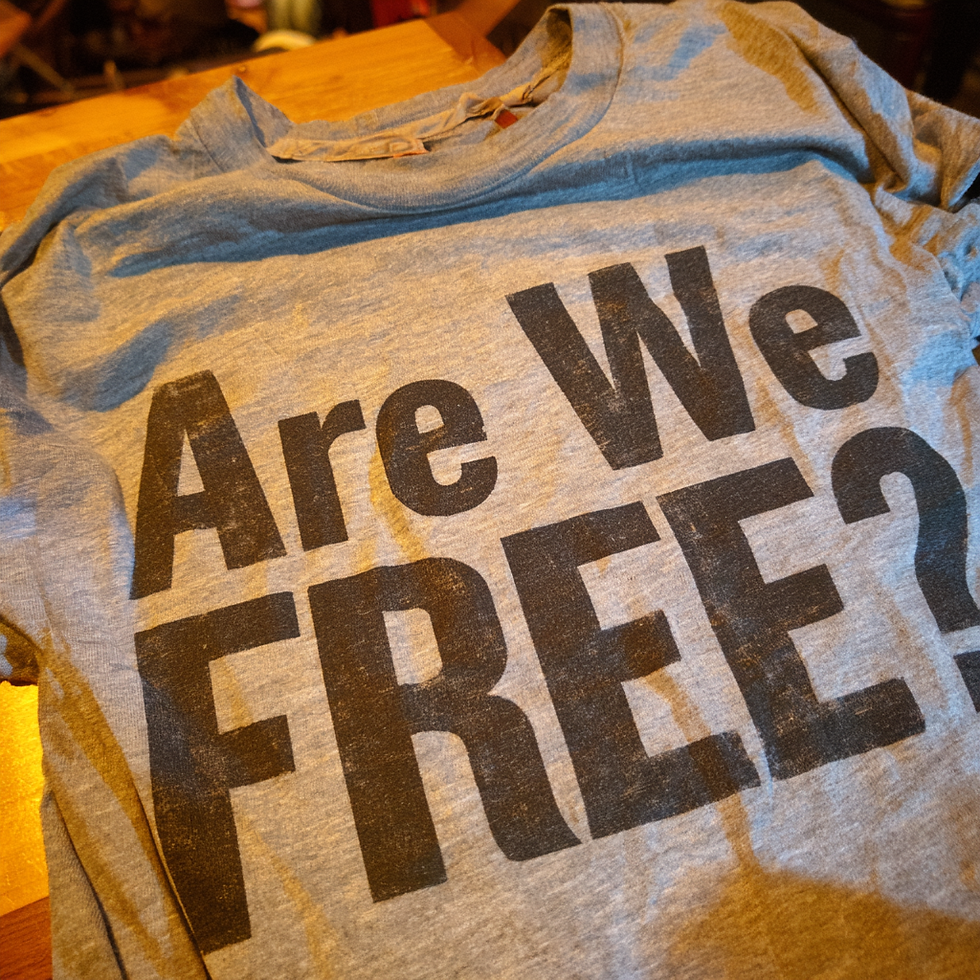
I was dropping my children off at school this morning when I saw a woman walking in with her two children, her husband beside her. What caught my eye was her shirt: three words on the back, Are we free?
It was notable enough that a thought formed almost on its own: I wonder what she means by that. I don't have anything else to go on: no more information, no chance to ask her, just the shirt and the question it left behind. I could probably guess how the world would answer it, but I'm sure the answer would be hard to pin down to a fine point. The question stayed with me the whole drive home.
What is freedom? And who has the right to say?
Ask around and you'll get several answers. Some will say freedom is doing what you feel, so long as it doesn't hurt anyone else. Others will say it's whatever a majority can agree helps people, or whatever a conscience can defend, or whatever can be tested and shown to work. There's a problem hiding inside that account, though, and it isn't about freedom first. It's about truth. If what's true is only what people can agree on, then truth changes as people change. But something believed differently by a thousand people isn't different underneath. What's true doesn't move just because our grip on it does.
Freedom, then, isn't first a question about what we're allowed to do. It's a question about who has the standing to say — no, that's not quite right either. It's a question about who made the thing we're all arguing over in the first place.
There's an answer to that older than any of us arguing over it.
In the beginning was the Word, and the Word was with God, and the Word was God. He was in the beginning with God. All things were made through him, and without him was not any thing made that was made. — John 1:1-3, ESV
Everything that exists came into being through him, including the categories we argue inside of: good and evil, bondage and freedom, truth and its counterfeits. That puts him in a different category than every other definition on the table. The others come from people who are themselves part of what was made; his claim doesn't start there, since everything that was made, including the people making the arguments, came into being through him.
And the Word became flesh and dwelt among us, and we have seen his glory, glory as of the only Son from the Father, full of grace and truth. — John 1:14, ESV
The Creator didn't stay outside what he made.
This is the one speaking, then, to a crowd that had only just begun to believe him.
So Jesus said to the Jews who had believed him, 'If you abide in my word, you are truly my disciples, and you will know the truth, and the truth will set you free.' They answered him, 'We are offspring of Abraham and have never been enslaved to anyone. How is it that you say, "You will become free"?' Jesus answered them, 'Truly, truly, I say to you, everyone who practices sin is a slave to sin. The slave does not remain in the house forever; the son remains forever. So if the Son sets you free, you will be free indeed.' — John 8:31-36, ESV
Notice what he doesn't do. He doesn't argue for freedom as a nicer feeling or a smarter policy. He ties it to abiding in his word, to knowing the truth, to being set free by the Son specifically. The people listening bristle. They already consider themselves free; they're Abraham's offspring, never enslaved to anyone. Jesus isn't talking about Rome. He's talking about sin, and about a freedom that doesn't wait on circumstance to grant it.
Here's the trouble the shirt's question can't answer on its own, no matter who's wearing it or what they meant by it. A person can recognize what's good. A person can do a great deal of it. Neither ability puts a person at the root of where goodness comes from, or gives it the power to save anyone. No one has ever argued, voted, or felt their way out of death.
For the wages of sin is death, but the free gift of God is eternal life in Christ Jesus our Lord. — Romans 6:23, ESV
Sin doesn't ask permission before it pays its wage. Every definition of freedom that stops at circumstance, whether that's doing what you want, believing what helps, or living as you see fit, eventually runs into a wall none of us can walk through on our own strength.
This is where the shirt's question finally gets an answer worth wearing. Freedom, on Christ's terms, wasn't an idea he floated from a distance. It was purchased with "the precious blood of Christ" (1 Peter 1:18-19, ESV), for anyone who will receive it:
For freedom Christ has set us free; stand firm therefore, and do not submit again to a yoke of slavery. For you were called to freedom, brothers. Only do not use your freedom as an opportunity for the flesh, but through love serve one another. For the whole law is fulfilled in one word: 'You shall love your neighbor as yourself.' — Galatians 5:1, 13-14, ESV
Look at what that just did to the idea of a master. Freedom isn't the absence of one. It's a change of masters — and unlike the one sin had you serving, this one has your good in view, not your ruin:
But now that you have been set free from sin and have become slaves of God, the fruit you get leads to sanctification and its end, eternal life. — Romans 6:22, ESV
When Jesus knelt to wash his disciples' feet, he didn't ask to be relieved of the title:
You call me Teacher and Lord, and you are right, for so I am. — John 13:13, ESV
Then he did the servant's work anyway, so they would do the same for each other. The same reversal shows up when the disciples are still arguing about greatness. The one who would be first, Jesus says, must become "slave of all," and the reason he gives is his own:
For even the Son of Man came not to be served but to serve, and to give his life as a ransom for many. — Mark 10:44-45, ESV
I still don't know what the woman I saw this morning meant by her shirt. I hope she finds where the question finally lands. But here's what I keep coming back to: freedom isn't ours to define, because the One who made everything is the only one with the authority to define it. He didn't just tell us what freedom means. He purchased it, and he's holding it out to us now. Are we free? That was never a question we could settle on our own terms. It was always his to answer. He already has.
Developed with the assistance of AI writing tools, under the author's full theological review and final editorial control.