The Best Thing About Being Lost


Just before Luke 15, great crowds were following Jesus, and He turned around and told them what following Him would cost. Count it first, He said, like a man building a tower; whoever would not renounce all he had could not be His disciple (Luke 14:28-33). He closed with a line He used more than once: "He who has ears to hear, let him hear." (Luke 14:35, ESV) Then Luke tells us who came close next. The tax collectors and sinners were all drawing near to hear Him, and the Pharisees and scribes grumbled, "This man receives sinners and eats with them." (Luke 15:2, ESV) The ones who heard the cost drew near to hear Him, and the ones who were sure of themselves stood back and grumbled.
I myself was lost and then found. And now, as a preacher, I am more mindful of the people who are lost and of the ones who are drifting. We are called to seek them. Jesus said of His own coming, "For the Son of Man came to seek and to save the lost." (Luke 19:10, ESV) James puts a share of that work in our hands: when one among us wanders from the truth, whoever brings him back will save his soul from death (James 5:19-20).
Jesus answers the grumbling with a shepherd and a woman. The shepherd leaves the ninety-nine in the open country and goes after the one that is lost "until he finds it" (Luke 15:4, ESV). The woman lights a lamp, sweeps the house and seeks diligently "until she finds it" (Luke 15:8, ESV). Notice what the searching takes. Time and focus. If I am honest, that is where this text presses on me. It is possible to care about the lost in general and never light the lamp for one of them.
Both stories end the same way, the sheep at verse 7 and the coin here: "Just so, I tell you, there is joy before the angels of God over one sinner who repents." (Luke 15:10, ESV) The shepherd goes after the sheep, and the sinner repents; Jesus keeps both in the same story, and so should we.
The third story shows the turning from the inside. The younger son takes his share into a far country and spends it until he is feeding pigs (Luke 15:13-16). Then "he came to himself" (Luke 15:17, ESV), and he got up and went home.
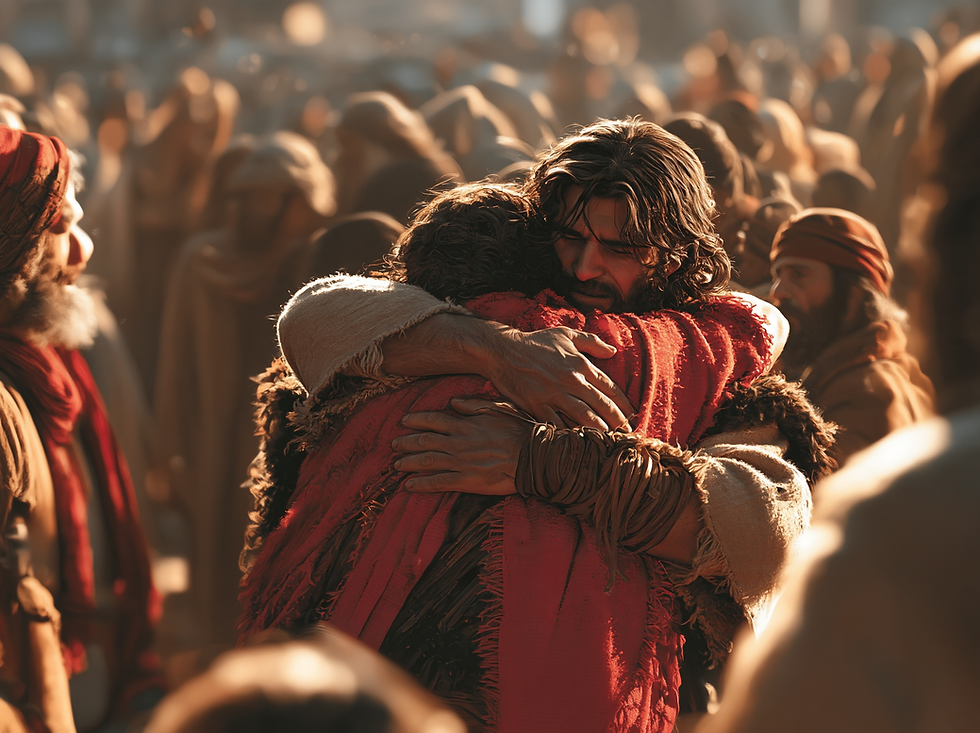
“But while he was still a long way off, his father saw him and felt compassion, and ran and embraced him and kissed him.” (Luke 15:20, ESV)
The son had to get up and walk; the father ran. He got his confession out, and the father was already calling for the best robe, a ring and the fattened calf. He gave the reason in a single line: "he was lost, and is found." (Luke 15:24, ESV)
The best thing about being lost is being found.
I think about a man who started coming regularly. He came close to being baptized, and then he became discouraged, because he realized what it was going to cost. He reminds me of the ruler in Luke 18 who asked Jesus what he must do to inherit eternal life. Jesus told him to sell all that he had and come follow Him. "But when he heard these things, he became very sad, for he was extremely rich." (Luke 18:23, ESV) The more we invest in the world and its comforts the harder it is to release all of those things. Ultrarunners have a saying for the aid stations late in a long race: beware the chair. There is nothing wrong with the chair. It is only easier than the miles still ahead, and the runner who settles into it may not get up again. Jesus said it of wealth: "How difficult it is for those who have wealth to enter the kingdom of God!" (Luke 18:24, ESV) Difficult is the word He chose. When the listeners asked who could be saved, then, He answered, "What is impossible with man is possible with God." (Luke 18:27, ESV) The Father's compassion runs down the road, and the cost is still real. We cannot count it for anyone else.
There is one more son. The older brother comes in from the field, hears music and dancing, and "he was angry and refused to go in" (Luke 15:28, ESV). He had never left home, and he was still standing outside. So the father did for him what he had done for the younger one; he went out. "His father came out and entreated him" (Luke 15:28, ESV), and told him, "Son, you are always with me, and all that is mine is yours." (Luke 15:31, ESV) Jesus ends the story there, with the door open, and He was telling it to the men who had grumbled in verse 2.
So what does it cost to follow once we are found? Giving up self, daily, dying to self, daily, walking in step with the Spirit, daily. Daily. Jesus said it to all who would come after Him: "let him deny himself and take up his cross daily and follow me" (Luke 9:23, ESV). Paul says it to people who already belong to Christ: "If we live by the Spirit, let us also keep in step with the Spirit." (Galatians 5:25, ESV) The cost is counted before the water, and the cross is taken up again tomorrow morning.
If you are drifting, the road home is open, and you will find a Father who sees a long way off. If you are standing where the man who came regularly stood, counting what it will cost, the New Testament tells you what coming home looks like: "Repent and be baptized every one of you in the name of Jesus Christ for the forgiveness of your sins" (Acts 2:38, ESV). If you are already home, keep a lamp lit for somebody else. It costs us something every day, and the Father's word over the one who comes home has not changed: "he was lost, and is found" (Luke 15:24, ESV).
Scripture quotations are from the ESV® Bible (The Holy Bible, English Standard Version®), copyright © 2001 by Crossway, a publishing ministry of Good News Publishers. Used by permission. All rights reserved. ESV Text Edition: 2016.
Drafted with AI assistance from Herbert Berkley's own words and reviewed by him.