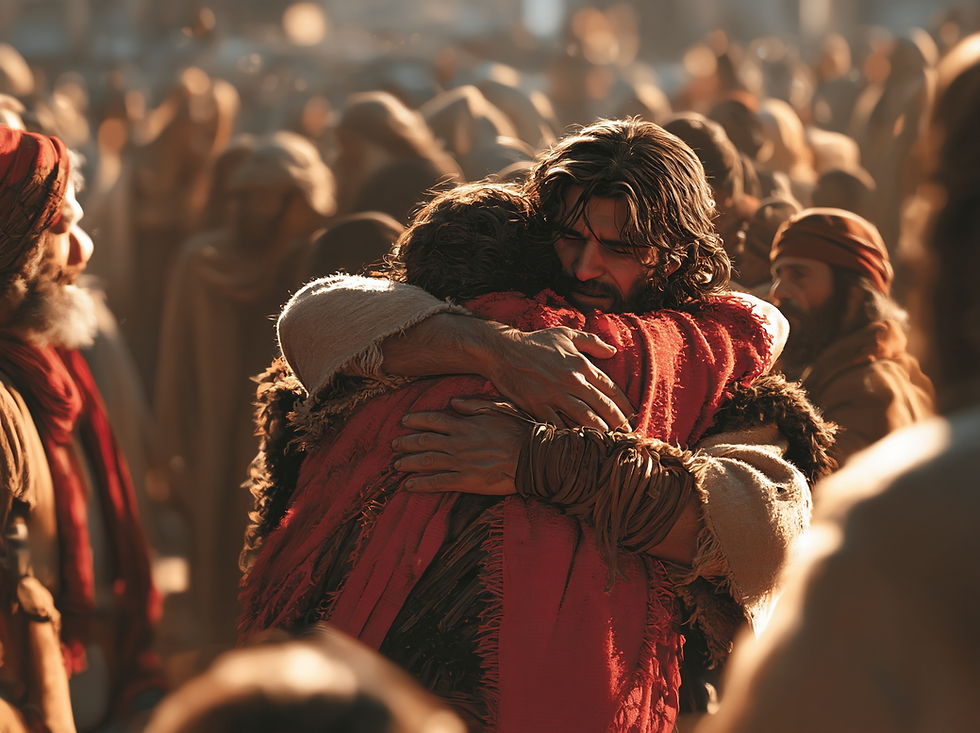
The Bridge He Became


We do not always want the truth. We say we do. We worship the idea of it. We hang it on the walls of our homes, pin it above our desks, and sometimes put it on the bumper of our cars. But when truth becomes a mirror, something in us starts looking for the door.
The reason is buried in the promise itself. Jesus does not say the truth will inform us, or improve us. He says it will free us, and freedom is only good news to someone who is bound. To be handed freedom is to be told, in the same breath, that we were slaves. That is the sentence we cannot get easily. We would rather argue with the doctor than accept the diagnosis. We would rather dismiss the truth than admit the chains it came to remove.
In John 8 we can watch it happen in real time. Jesus makes the offer:
If you abide in my word, you are truly my disciples, and you will know the truth, and the truth will set you free. — John 8:31–32, ESV
And the answer comes back fast, almost before he finishes:
We are offspring of Abraham and have never been enslaved to anyone. How is it that you say, 'You will become free'? — John 8:33, ESV
Never enslaved to anyone. This from a nation that spent four hundred years making bricks in Egypt, whose whole story opens with a rescue out of a house of slavery they could not walk out of on their own. They are not lying, exactly. They have done what we all do. They filed the bondage under history and told themselves the chains were someone else's, long ago. And so they stand in front of Freedom himself and inform him they have never needed him. He does not minimize it. Hear these words.
Truly, truly, I say to you, everyone who practices sin is a slave to sin. The slave does not remain in the house forever; the son remains forever. So if the Son sets you free, you will be free indeed. — John 8:34–36, ESV
So the slavery was never only Egypt, and never just ancient. It is present tense, and it is personal, and it has an address we have met before. Not a country but the heart.
Jesus had already named the place plainly:
For from within, out of the heart of man, come evil thoughts, sexual immorality, theft, murder, adultery, coveting, wickedness, deceit, sensuality, envy, slander, pride, foolishness. All these evil things come from within, and they defile a person. — Mark 7:21–23, ESV
That is the house we cannot walk out of on our own. The chains are not on the wrists. They run further in than we like to look. And we say it too, in our own voice. We would never use the word slave. But we live the sentence. We spend a life becoming someone. A title. A part of town good enough to talk about without flinching. A number in an account. A reputation that walks into the room ahead of us. The family we came from. We call that becoming freedom, and for a while it feels like exactly that. What we miss is the hour the thing we were building turned and began building us, until the schedule owned the man and the number owned the marriage and the good name owned our words. Nearly everything around it agrees that it belongs in charge. The people we know treat it as normal. Even the face in the mirror does. Scripture has a plain word for what happens when a person rises to become the master of his own self:
They promise them freedom, but they themselves are slaves of corruption. For whatever overcomes a person, to that he is enslaved. — 2 Peter 2:19, ESV
The promise was always freedom. That is the whole trick of it. The thing we are chasing always calls itself freedom, and the weight settles so slowly that most of us are halfway across a life before we feel it on the ankle. And here is the part that is hard to confess: while it is happening, it does not feel like bondage at all. It feels like a full life. Their chain had a covenant stamped on it, offspring of Abraham, a heritage no one could enslave. Ours has our own name on it, and the iron shackle holds the same.
Which means freedom cannot be somewhere we relocate to. There is no free country to move to when the border runs straight through your own chest. The free ground is not a place at all. It is a person: the one man who was tempted at every point and stayed unbound, the only sinless person known to man, who was a man himself. Between us and him is a gap, and it was not measured recently:
But your iniquities have made a separation between you and your God, and your sins have hidden his face from you. — Isaiah 59:2, ESV
A separation. A canyon quarried one choice at a time, until the far edge went out of sight. And our first instinct, standing at the rim, is the same instinct as never enslaved to anyone. We will build our own way across. Babel is that instinct set in stone:
Then they said, 'Come, let us build ourselves a city and a tower with its top in the heavens, and let us make a name for ourselves, lest we be dispersed over the face of the whole earth.' — Genesis 11:4, ESV
Notice the brick. Egypt's bondage was measured in bricks too. You cannot lay a road to freedom out of the same material your chains were made from. Every span thrown from our side runs out of timber over open air. And here I want to be careful — the picture can turn sentimental fast, and this one is not. He did not lower a drawbridge and step back to watch us cross. He built the span by becoming it.
I am the way, and the truth, and the life. No one comes to the Father except through me. — John 14:6, ESV
Not I will show you the way. I am the way. The cross is where he stretched himself over the gap and let his own body carry the load the canyon demanded. There has only ever been one way across, and it has a face. And he does not leave us to cross alone, hoping the boards hold. He goes out onto the span ahead of us and turns to walk it back at our side. This is how he calls the ones already worn down by the road:
Come to me, all who labor and are heavy laden, and I will give you rest. Take my yoke upon you, and learn from me, for I am gentle and lowly in heart, and you will find rest for your souls. For my yoke is easy, and my burden is light. — Matthew 11:28–30, ESV
We come onto the bridge heavy laden. That is his word for us, not a charge we bring against ourselves. And then he does the thing no one expects on a hard road. He lifts the pack off our shoulders. The load that would have put us on the ground, he carries the rest of the way, because the one who made the crossing does not stand back and watch us make it on our own. There is wind on this bridge. There are nights the far side is invisible and the boards feel thin under your feet. The love that started us across does not thin with the weather:
Now before the Feast of the Passover, when Jesus knew that his hour had come to depart out of this world to the Father, having loved his own who were in the world, he loved them to the end. — John 13:1, ESV
To the end. To the end of the span, through the middle of the crossing, where love is proven, out in the weather. Some nights that is all you will have to go on. Not enough to feel, some nights. Only enough to keep walking on.
How does anyone get onto it? Not by climbing. Babel already tried the climb.
The doorway is given, and Scripture is plain about where it stands:
For as many of you as were baptized into Christ have put on Christ. — Galatians 3:27, ESV
Do you not know that all of us who have been baptized into Christ Jesus were baptized into his death? We were buried therefore with him by baptism into death, in order that, just as Christ was raised from the dead by the glory of the Father, we too might walk in newness of life. — Romans 6:3–4, ESV
Brought up out of the house of slavery through the water and placed into the One who is himself the way across. This is how the Father sets us free, and free indeed. Not by improving the slave, but by joining us to the Son who remains in the house forever. And the bridge leads to the place of rest. It does not trail off into cloud. It sets down inside a city that comes down to meet it:
But nothing unclean will ever enter it, nor anyone who does what is detestable or false, but only those who are written in the Lamb's book of life. — Revelation 21:27, ESV
Then the angel showed me the river of the water of life, bright as crystal, flowing from the throne of God and of the Lamb through the middle of the street of the city; also, on either side of the river, the tree of life with its twelve kinds of fruit, yielding its fruit each month. The leaves of the tree were for the healing of the nations. — Revelation 22:1–2, ESV
The garden that was sealed opens again at the far end. We do not climb back into it. We are carried in and set down, and the slave who could not remain in the house arrives, at last, as a son who does.
So take the invitation as spoken to you, because of who he is. It is the same word he gave at the start: remain in him, and the truth he shows you is the truth that frees. If you have never been joined to him, the way in is the water. Go down with him and come up his. And if you are already on the span, and the boards feel thin tonight, this is the whole of what the crossing asks. Keep your feet on him, and keep walking. The one who built it has the other end.
He built it. He carries us across it. He walks it at our side, and he loves us the whole way home. Back to the truth we ran from at the start, the truth that was the door all along. Are you ready to respond?
Developed with the assistance of AI writing tools, under the author's full theological review and final editorial control.