The Cost of Following

Updated: Sep 14

"For which of you, desiring to build a tower, does not first sit down and count the cost, whether he has enough to complete it? Otherwise, when he has laid a foundation and is not able to finish, all who see it begin to mock him, saying, 'This man began to build and was not able to finish.' Or what king, going out to encounter another king in war, will not sit down first and deliberate whether he is able with ten thousand to meet him who comes against him with twenty thousand? And if not, while the other is yet a great way off, he sends a delegation and asks for terms of peace. So therefore, any one of you who does not renounce all that he has cannot be my disciple." Luke 14:28–33, ESV
What It Says
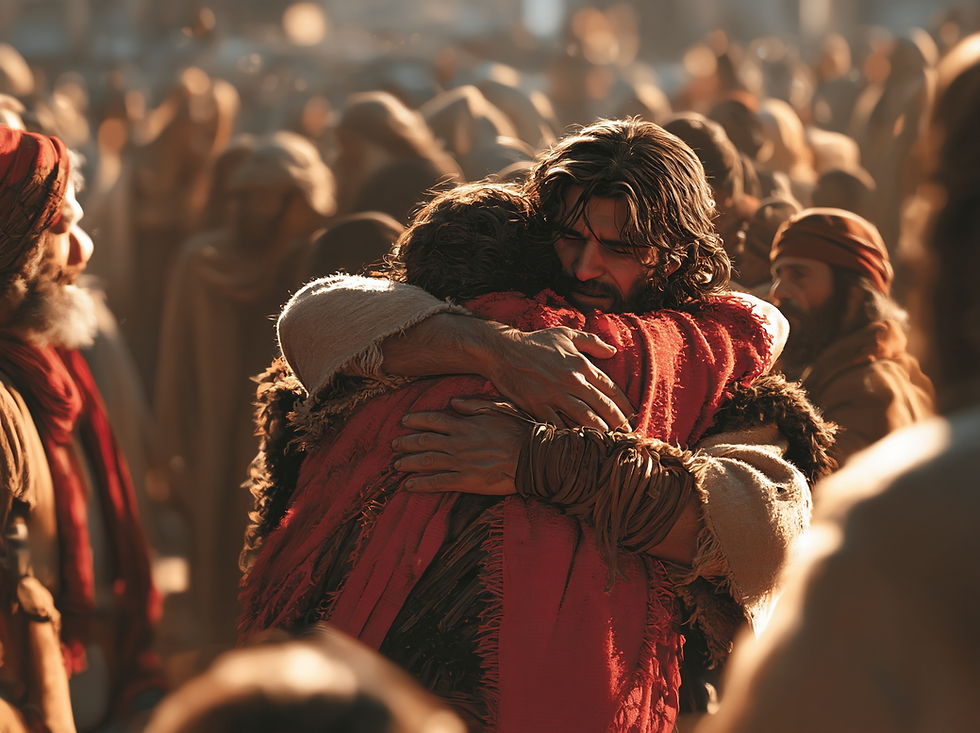
Jesus is speaking in the context of a large crowd following him, and that crowd becomes the occasion for what he says next. He does not greet the size of it. He narrows it. Two brief illustrations, a builder and a king, and then a sentence that answers both.
The builder wants to put up a tower. Before the first stone goes down, the question is simple: do you have enough to finish? If not, and you build anyway, you will end up standing in front of an unfinished project and a crowd that has already made up its mind about you. The mockery is not the main point. The unfinished state is.
The king in the second story is outnumbered two to one. He either believes he can win, or he sends an envoy. There is no third option once the lines are drawn. And he has to decide before the army arrives, not after. Then comes verse 33. No more illustrations. Just the conclusion Jesus was building toward: "any one of you who does not renounce all that he has cannot be my disciple." The two stories were not decoration. They were the cost-counting exercise, and the number at the bottom is everything.
What It Means — Then and Now
Jesus is addressing people who were following him in large numbers but following him on their own terms. Luke 14 opens with a dinner at a Pharisee's house and moves through three parables before arriving here, each one pressing the question of who will actually enter the kingdom and on what grounds. The crowd was mixed. Some were disciples. Some were curious. Some were drawn to the spectacle. Jesus does not encourage them. He warns them.
The principle at work is older than this scene. When Elisha received the call to follow Elijah, he killed his oxen and burned his equipment, no return path, no fallback. He kills what he could have returned to. The NT does not invent this logic; it inherits it and sharpens it.
We are not in first-century Galilee, but the same crowd is still forming. People draw near to Jesus for many reasons, and not all of them have counted anything. We read the promises, the comfort, the good news, and we should. But Jesus himself, in this passage, insists that those promises cannot be received by a person who has not first laid down everything they might use as a substitute.
What It Doesn't Mean
This passage does not mean that following Jesus requires physical destitution. Jesus had disciples who owned boats, homes, and property. The word translated "renounce" in verse 33 refers to releasing the claim of ownership, not necessarily the thing itself, but the hold it has on you.
I'll admit that distinction can sound too convenient. But the passage enforces it. Neither the builder nor the king is told to be impoverished, both are simply told to count first. The standard in verse 33 is not poverty. It is the absence of a privately held reserve.
It also does not mean that Jesus is even trying to discourage people from following him. He is insisting that whoever enters must enter knowing what is being asked. That is not discouragement. It is honesty.
What it does mean is that a kind of half-following is possible, a discipleship that retains a private reserve, something held back, a life that belongs to Jesus in most areas but quietly maintains a clause for one or two others. Jesus is ruling that out. "Any one of you," the scope does not narrow. The requirement is the same across the crowd.
How Do We Apply It
We are not good at auditing our own holdings. We tend to count what we have surrendered and present the sum as evidence of discipleship, while the thing we have not laid down stays off the ledger entirely. That is the ordinary version of this failure, not dramatic defiance, just a quiet exception we stopped examining. I didn't really count it until something I wanted to keep came up against something the kingdom was calling me toward — and I found out which one I was actually holding.
The builder in this passage is not someone who refused to count. He counted, came up short, and built anyway. We are probably closer to him than we like to think.
What does it look like, in ordinary terms, to release all that you have? It does not look like a single transaction. It looks like a posture, one in which the claim of ownership over your time, your plans, your relationships, and your future has been genuinely laid down, and Jesus is the one deciding what you pick back up.
Where Does Jesus Come In
The requirement Jesus sets here is one that no one in the crowd meets, and one that Jesus himself fulfilled. Paul wrote to the church at Philippi about someone who did exactly what this passage asks:
"Who, though he was in the form of God, did not count equality with God a thing to be grasped, but emptied himself, by taking the form of a servant, being born in the likeness of men. And being found in human form, he humbled himself by becoming obedient to the point of death, even death on a cross." Philippians 2:6–8, ESV
He did not hold anything back. The emptying went all the way down.
He is not setting before us a standard he watched from a distance. He counted the cost. Ahead of the crucifixion, in the garden, with full knowledge of what the morning would cost. And he paid it. The one calling us to let go of everything is the one who let go of everything first. That means the passage does not end with a demand the crowd cannot meet and a door that stays closed. It ends with a person who has already walked through it and held it open.
Is there anything you are still holding that you have not yet released to him?
Developed with the assistance of AI writing tools, under the author's full theological review and final editorial control.