QFD | Love on the Fault Line

Love on the Fault Line
Everyone has heard it. John 3:16—the verse so familiar it has become furniture in the room of Western culture. We walk past it without seeing it.
And that is precisely the problem.
A verse about the most costly act in cosmic history has been domesticated into a slogan. We have made it comfortable. The world hears "God so loved" and nods along, assuming it already knows what love means. But here is where the fracture opens—what love means to the world is often sin to the Father.
Consider how we use the word. Love is invoked to justify nearly anything. Love is patient, we say, so do not judge. Love is kind, so do not confront. Love accepts, so do not call anything wrong. Man wants to construct his own kingdom of love, with himself on the throne, deciding what the word permits and what it forbids.
But John 3:16 does not hand us a feeling. It hands us a cross.
"For God so loved the world, that he gave his only Son, that whoever believes in him should not perish but have eternal life" (John 3:16, ESV).
Notice the structure. Love is not described as an emotion God felt. Love is described as an action God took. He gave. The verb is concrete. Costly. Final. This is not the love of greeting cards. This is the love that sacrifices the most valuable thing for the sake of the undeserving. The Son, the only Son, given. Not loaned. Not conditional. Given.
I don't know how to say this without it sounding personal, because it is. Discussing love in modern life gets messy. Everyone has their own definition, their own boundaries, their own exceptions. Conversations turn into minefields. But God does not negotiate definitions. His love is not shaped by our preferences; it is revealed in His action. And that action looked like wood, nails, and blood.
The world uses love as a cover for sin. "I love them, so it must be okay." "Love is love." We have heard the slogans. But Scripture presents something sharper: love is the cross. Real love confronts what destroys the beloved. It pays the cost to rescue—not to excuse. God did not look at a rebellious world and say, "I love you as you are, so stay as you are." He said, "I love you so much that I will give everything to make you something new."
This is where the verse collides with the kingdom we've been constructing—the one where love means permission and acceptance means approval.
The text continues with a condition and a consequence—"whoever believes in him should not perish." Belief is the hinge. Not admiration. Not vague spiritual appreciation. Belief that responds to what God has done, that trusts the Son He gave, that accepts the rescue on His terms rather than ours. The alternative is perishing. Jesus does not soften this. The very next verses make it plain: "And this is the judgment: the light has come into the world, and people loved the darkness rather than the light because their works were evil" (John 3:19, ESV).
There it is—people loved darkness. The word loved again. We are all lovers. The question is never whether we will love, but what we will love and by whose definition. The world clings to its own version because that version permits the darkness to remain. God's love exposes the darkness and offers a way out—but the way out cost Him His Son.
Maybe that is why the verse has become a cliché.
Easier that way.
But return to the text. Hold it. God so loved—to this degree, in this manner, at this cost—that He gave. The giving is the measure of the loving. And what He gave was not a principle or a program. He gave a Person. His only Son.
The Old Testament sacrificial system taught Israel that sin required blood. Life for life. Something must die so that something else might live. Every lamb on every altar pointed forward to this moment—the Lamb of God, given for the world. John the Baptist saw Him and said it plainly: "Behold, the Lamb of God, who takes away the sin of the world" (John 1:29, ESV). The whole story bends toward the cross.
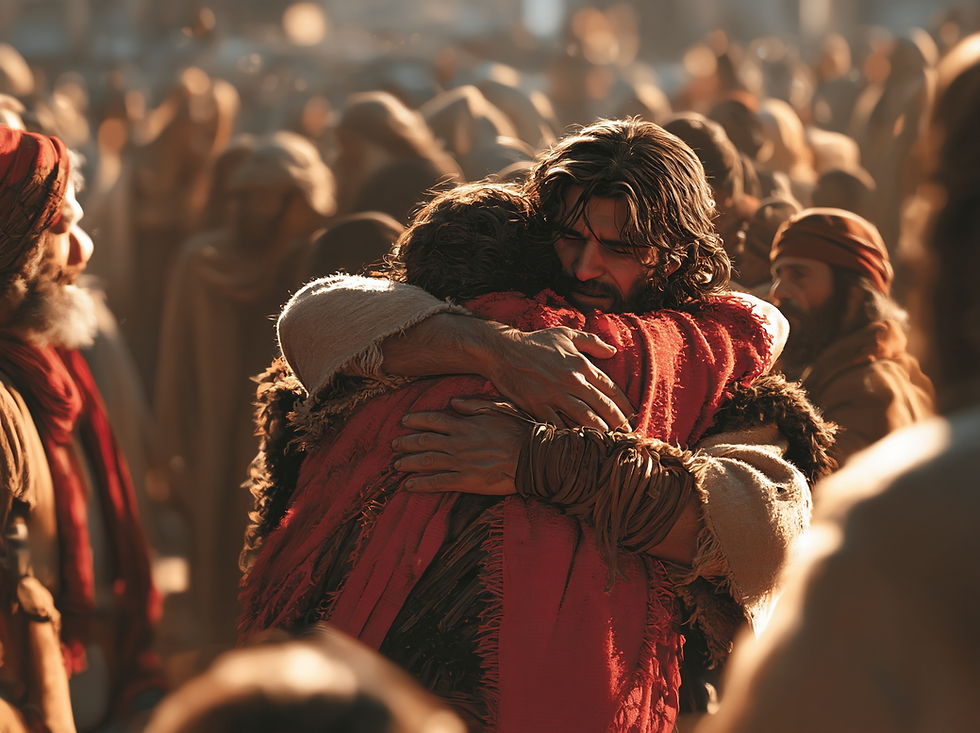
So when we speak of love now, we must speak of this. Love is not a sentiment we feel but a sacrifice we witness. Love is eternal and it came with a price. The Father gave the Son. The Son gave His life. And we are invited—not forced, not coerced, but invited—to believe and receive.
On one side stands the world's love, self-constructed, self-serving, covering what it should confront. On the other stands the cross, where God's love was measured out in blood for people who did not deserve it.
We each stand somewhere. The question is not whether we have heard the verse. We all have. The question is whether we have let God define what it means—or whether we are still holding the chisel, carving a god who looks like us.
Developed with the assistance of AI writing tools, under the author's full theological review and final editorial control.