QFD |The Persecuted Mindset


The Persecuted Mindset
In some workplaces—and in certain corners of the world—faith in Christ carries a price. Perhaps you know this weight: rising each morning under the quiet dread that today might be the day you are called in, singled out, or quietly pushed aside because you follow Jesus. Not everyone reading this faces imminent termination. But many feel the psychological burden of possible retribution for their convictions.
If you live in this tension, you are not alone—and you are not the first.
Clay on the Wheel
The prophet Isaiah spoke for God's people when he wrote:
"But now, O LORD, you are our Father; we are the clay, and you are our potter; we are all the work of your hand." (Isaiah 64:8, ESV)
There is comfort in this image, but also discomfort. Clay does not choose where the potter's hand presses. It does not control the speed of the wheel. Living under constant uncertainty—unsure whether a conversation with HR awaits, whether your contract will be renewed, whether mentioning church will cost you a promotion—can feel exactly like this. Spinning. Pressed. Uncertain where the next pressure will land.
Yet the hands pressing are not hostile. They are the hands of the One who formed you. The same God who shapes nations and topples empires concerns Himself with the contours of your character. Even unwelcome pressure can serve His purposes.
This does not make the pressure pleasant. But it reframes it. The question is not whether the wheel will spin or the hand will press. The question is whether we will resist the shaping or submit to the Potter who knows what He is making.
Sheep Among Wolves
Jesus did not send His disciples into the world with promises of safety. He sent them with clear-eyed warnings:
"Behold, I am sending you out as sheep in the midst of wolves, so be wise as serpents and innocent as doves." (Matthew 10:16, ESV)
Sheep among wolves. Not a comforting image. Wolves do not negotiate with sheep. They do not respect boundaries. And yet Christ sends us out anyway—not naively, but wisely. Shrewdness paired with innocence. Awareness of danger coupled with refusal to adopt the wolf's methods.
The early church lived this reality with a literalness most of us will never experience. They faced execution, property seizure, family separation, public torture. We ought to be careful not to equate a difficult performance review with the blood of the martyrs. The stakes differ. But the principle holds: faithfulness to Christ may cost us, and that cost—whatever its magnitude—is meant to refine us, not destroy us.
Peter, who watched his Lord crucified and later faced his own execution, wrote to scattered believers under Rome's shadow:
"Beloved, do not be surprised at the fiery trial when it comes upon you to test you, as though something strange were happening to you. But rejoice insofar as you share Christ's sufferings, that you may also rejoice and be glad when his glory is revealed." (1 Peter 4:12-13, ESV)
Do not be surprised. The trial is not an interruption of the Christian life. It is part of its fabric.
Guarding What Matters Most
A garden neglected will be overtaken. Weeds do not wait for permission. In hostile environments—whether ancient Rome or your contemporary office—spiritual weeds like fear, resentment, and bitterness sprout quickly if left untended.
Solomon's wisdom cuts to the heart of the matter:
"Keep your heart with all vigilance, for from it flow the springs of life." (Proverbs 4:23, ESV)
The Hebrew word for "keep" carries the force of guarding, protecting, watching over. This is not passive maintenance. It is active vigilance. When you feel threatened, when you suspect your days at a job are numbered, when you sense that your faith has made you a liability—these are precisely the moments when the heart requires guarding.
What weeds threaten your garden? Anxiety that spirals into sleeplessness? Resentment toward colleagues who seem unbothered by conviction? Bitterness toward leadership that rewards compromise? Self-pity that whispers you deserve better?
Name the weed. Then uproot it—not once, but repeatedly, as often as it returns. Meditate on Scripture that speaks directly to the lie the weed represents. Confess it to a trusted brother or sister. Bring it before the Lord who promises that His Spirit will help us in our weakness (Romans 8:26).
Your heart, kept with vigilance, becomes its own testimony. A gentle spirit in a hostile place preaches more clearly than a thousand arguments.
Outside the Camp
The writer of Hebrews addressed Jewish Christians tempted to retreat—to slip back into the familiar rhythms of the old covenant, where belonging felt safer, where the reproach of Christ could be avoided. His call was stark:
"Therefore let us go to him outside the camp and bear the reproach he endured." (Hebrews 13:13, ESV)
In its original context, "the camp" was the religious establishment that rejected Jesus—the temple system, the sacrificial order, the community that crucified the Messiah outside Jerusalem's walls. To follow Christ meant leaving that camp behind.
The principle extends beyond first-century Judaism. Every believer faces some version of "the camp"—a community, a system, a workplace culture where belonging requires compromise. To follow Christ may mean being regarded as an outsider by whatever camp we once belonged to.
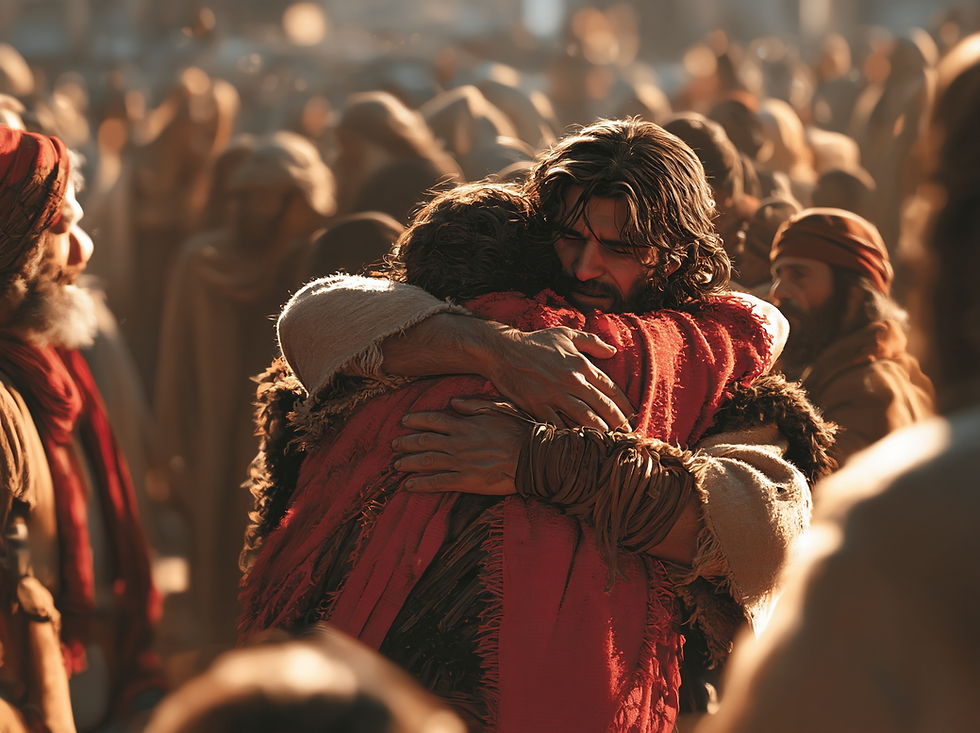
But notice where Christ stands. He is already outside the camp. He was cast out first. When we bear reproach for His name, we do not walk alone into exile. We walk toward the One who waits there, arms open, having borne the reproach before us.
Can you picture this? In the moment of potential dismissal, in the HR conversation, in the quiet exclusion from the lunch invitation—Christ stands with you. The One who was rejected knows rejection. And He is not ashamed to call you brother, sister (Hebrews 2:11).
Joy in the Thorns
James opens his letter with counsel that sounds almost offensive to modern ears:
"Count it all joy, my brothers, when you meet trials of various kinds, for you know that the testing of your faith produces steadfastness. And let steadfastness have its full effect, that you may be perfect and complete, lacking in nothing." (James 1:2-4, ESV)
This is not naïve cheerfulness. James was no stranger to hardship; tradition holds he was martyred in Jerusalem. His call to joy is grounded in something deeper than circumstance: the knowledge that trials produce something. They are not meaningless. The testing of faith yields steadfastness—and steadfastness, given time, yields maturity and completeness.
Your workplace may feel like a path full of thorns. Every step snags. Every turn scratches. But consider: what is being produced in you that comfort could never forge? Patience? Dependence on Christ? Compassion for others who suffer? Clarity about what truly matters?
The thorns are real. The path is hard. But it leads somewhere. And the One who walks it with you endured thorns pressed into His own brow.
Standing Firm
What does faithfulness look like in practice? Not arrogant proclamation that invites unnecessary conflict. Not cowardly silence that denies Christ by omission. Something in between: gentle boldness, wise innocence, quiet integrity.
Let Scripture frame your day. Before you open your inbox, open the Word. Even a few verses, read slowly and prayerfully, can anchor your mind before you step into uncertainty. The Psalmist understood this rhythm: "In the morning, O LORD, you hear my voice; in the morning I lay my requests before you and wait expectantly" (Psalm 5:3, CSB).
Find fellowship that sustains. You were not designed to endure alone. Seek out at least one mature believer—inside your workplace or outside it—with whom you can share honestly. Pray together, even if briefly. Bear one another's burdens (Galatians 6:2). Isolation makes the weeds grow faster.
Pray for those in authority. Paul urged Timothy: "First of all, then, I urge that supplications, prayers, intercessions, and thanksgivings be made for all people, for kings and all who are in high positions" (1 Timothy 2:1-2a, ESV). Even if you suspect your supervisors are hostile, interceding for them shapes your own heart toward compassion rather than bitterness. It is hard to hate someone you are lifting before the throne of grace.
Rest in your true approval. Paul wrote to the Ephesians of God's glorious grace, "with which he has blessed us in the Beloved" (Ephesians 1:6, ESV). Your standing before God does not fluctuate with your performance review. You are in Christ—and that position is unassailable. While you may not hold your employer's lasting favor, you walk in the favor of the One whose opinion alone is eternal. This truth frees you from slavery to human approval.
The Anchor Holds
You cannot control the outcomes. You do not know whether tomorrow brings termination or tenure, hostility or unexpected kindness. What you can control is where you fix your eyes. What you can choose is the posture of your heart.
Paul reminded the Corinthians—a church no stranger to difficulty—of this unshakeable truth:
"Therefore, my beloved brothers, be steadfast, immovable, always abounding in the work of the Lord, knowing that in the Lord your labor is not in vain." (1 Corinthians 15:58, ESV)
Not in vain. Whatever you lose for Christ's sake is not lost. Whatever you suffer in faithfulness is not wasted. The labor may go unrecognized by employers. It may cost you advancement or comfort. But in the Lord, it counts. It lasts. It matters eternally.
Peter, who knew what it meant to suffer for the Name, offered this final counsel to believers under pressure:
"Therefore let those who suffer according to God's will entrust their souls to a faithful Creator while doing good." (1 Peter 4:19, ESV)
Entrust your soul. Not to the economy. Not to your employer's goodwill. Not to your own ability to navigate the politics. Entrust it to the faithful Creator—the One who made you, redeemed you, and holds you still.
He sustained the early church through fire and sword. He will sustain you through the anxious inbox, the tense meeting, the quiet exclusion. His faithfulness does not waver.
Go in peace. The Potter is at work. The Shepherd walks with you. And outside every camp that casts you out, Christ stands waiting.
To Him be glory in the church and in Christ Jesus throughout all generations, forever and ever. Amen. (Ephesians 3:21, ESV)
Developed with the assistance of AI writing tools, under the author's full theological review and final editorial control.